How to Read a Supplement Study Without a Science Degree
Almost every supplement is "backed by science." Here's how to tell whether the science is any good.

Every supplement on the shelf claims to be "backed by science." Most of them are, technically. There is almost always a study.
The question is whether it's a good one — and you can work that out with seven questions and no training whatsoever.
1. How many people were in it?
This is the fastest filter. A trial of 30 people can produce an exciting result purely by chance. A trial of 3,000 mostly can't.
Supplement research skews small: 50 to 150 participants is typical. That's not fraud, it's budget. But a small trial should move your opinion a little, not a lot. If a claim rests entirely on one study of 40 people, treat it as a promising hint rather than a finding.
2. Compared to what?
If everyone in a study takes the supplement and reports feeling better, that tells you almost nothing. People improve on their own, regress to their average, and respond to being cared for. That's the placebo effect, and it's large — especially for things you self-report, like mood, energy, sleep quality and pain.
You want a control group taking an identical-looking dummy pill, with neither participants nor researchers knowing who got what. That's "randomised, double-blind, placebo-controlled." If those words are missing, ask why.
3. Who paid for it?
This one is uncomfortable and well documented.
A Cochrane review of industry sponsorship found that manufacturer-funded drug and device studies more often reported results favourable to the sponsor's product — and that the effect couldn't be explained by the usual risk-of-bias measures. In nutrition research specifically, an analysis of articles on common beverages found the odds of a favourable conclusion were roughly seven times higher in fully industry-funded articles than in those with no industry funding.
This doesn't make sponsored research worthless. Someone has to pay, and companies fund most supplement trials because nobody else will. But funding belongs in your weighting, and it's usually disclosed at the bottom of the paper under "Conflicts of Interest." Read that bit.
4. Did they measure the thing you actually care about?
This is the trick most people miss.
A surrogate outcome is a marker that stands in for what matters: cholesterol instead of heart attacks, cortisol instead of feeling less stressed, bone density instead of fractures. Surrogates are cheaper and faster to measure — and they don't always track the real thing.
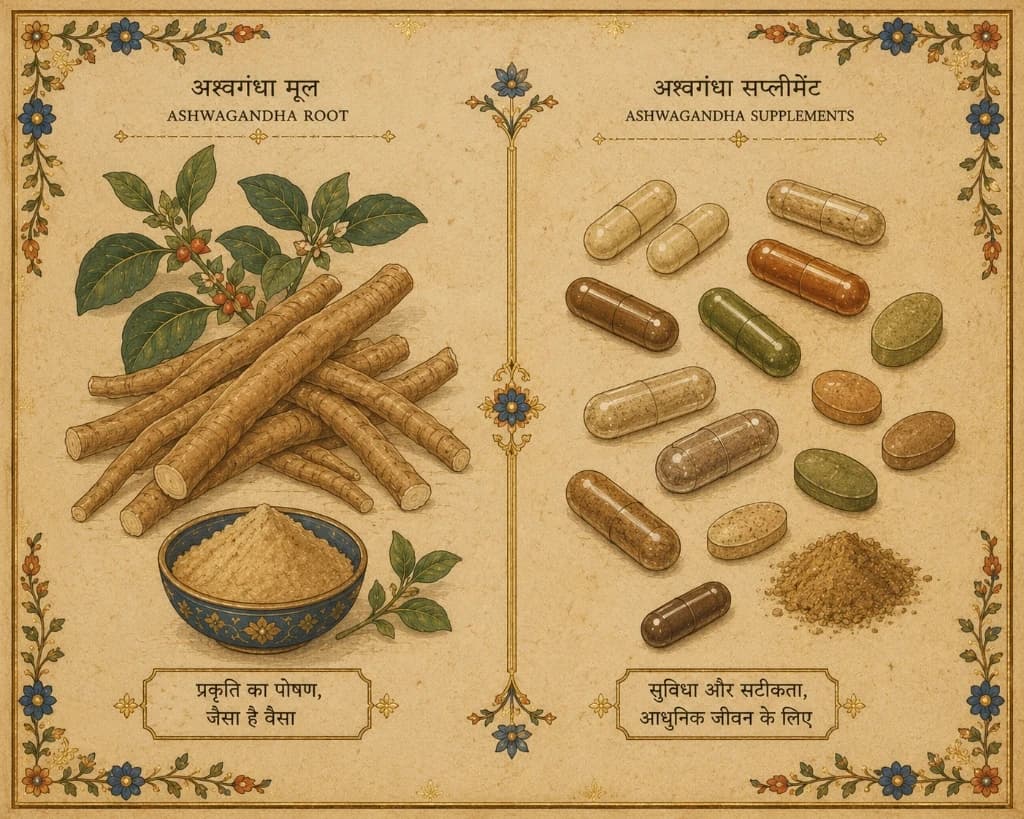
Ashwagandha is a clean example. Trials fairly consistently show it lowers cortisol. Whether people actually feel less stressed is much shakier, and some analyses find no effect on perceived stress at all. The blood marker moved. The experience may not have.
So ask: did they measure the outcome, or a proxy for it?
5. "Reduces risk by 50%" — of what, exactly?
Two ways to describe the same result:
- Your risk dropped from 2 in 1,000 to 1 in 1,000.
- Risk halved. 50% reduction.
Both are true. The second sells more product.
That's relative risk versus absolute risk. Whenever you see a big percentage with no baseline attached, go looking for the raw numbers. A 50% reduction in something that was already rare is a very small real-world benefit.
6. Was it people, mice, or a dish?
"Shown to kill cancer cells" often means cells in a petri dish, drenched in a concentration you could never reach by swallowing a capsule. Bleach kills cancer cells in a dish too.
Animal studies are a real step up, but the drop-off is steep. One 2024 analysis found only around 5% of therapeutic interventions tested in animals go on to win regulatory approval for human use.
Mice are not tiny people. In vitro is not in you. If the headline finding never made it into a human trial, that's the story.
7. Is this one study, or the whole picture?
Single studies are wrong all the time — not through misconduct, just noise. What matters is whether a finding replicates.
The most useful thing you can do is search for a systematic review or meta-analysis on the topic, which pools all the trials rather than the one a brand chose to cite. When you find one, check whether the individual studies agreed with each other. Reviews report this as "heterogeneity" — high heterogeneity means the trials pointed in different directions, and the tidy average is hiding a mess.
The ten-second version
Next time you see a claim on a label or in an ad, ask:
How many people? Compared to what? Who paid? Did they measure the real thing or a proxy? What's the absolute number? Humans or mice? One study or many?
You won't be able to evaluate the statistics. You don't need to. Most weak claims fail at question one or two.
One last thing, and we mean it: apply this to us as well. If we ever tell you something is "clinically proven" and the evidence is a 30-person, industry-funded, unreplicated study of a surrogate marker, you should call it. That's the whole point of teaching you the questions.
Sources: Lundh et al., Cochrane Database of Systematic Reviews, 2017 · Lesser et al., PLOS Medicine, 2007 · Animal-to-human translation analysis, PLOS Biology, 2024
Educational content, not medical advice. Ayurveda is complementary to medical care, never a replacement for it. Talk to a Vaidya or your doctor before changing anything you take.
Five minutes. No card.