Ashwagandha: What the Trials Found, and What They Didn't
The research is more promising than the skeptics admit and far messier than the labels suggest — and the capsule in your hand may not be the extract they studied.
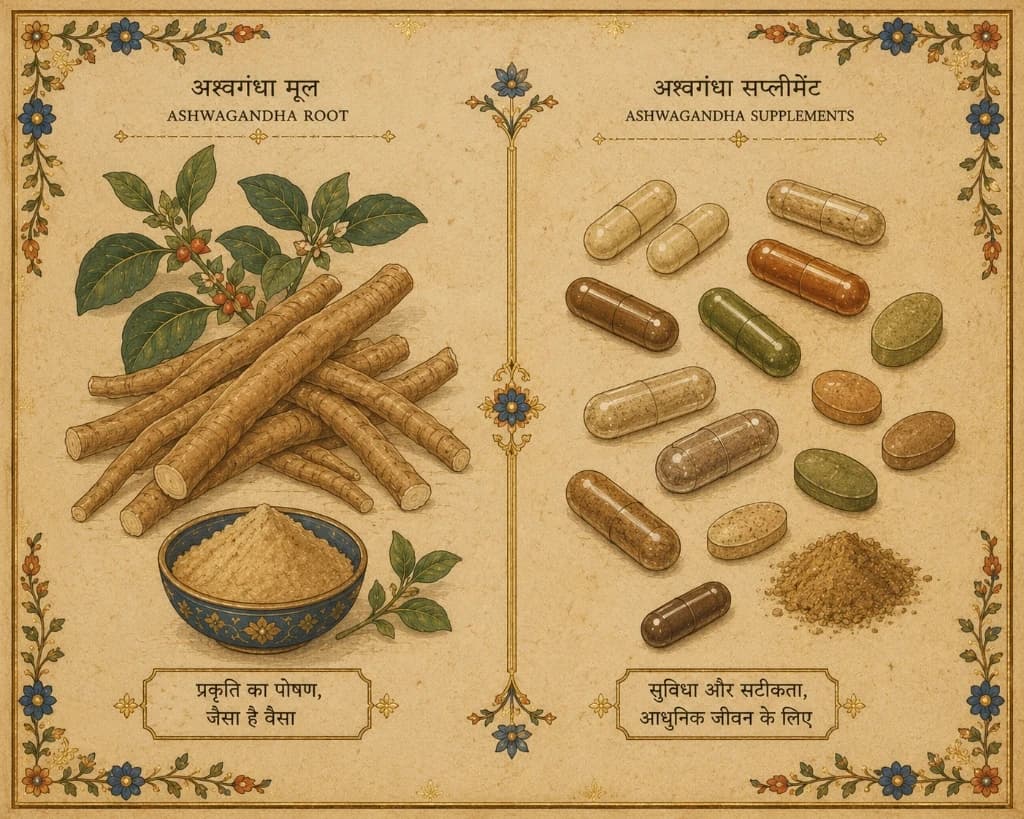
It's in your gummies, your sleepy-girl mocktail, your pre-workout and probably your flatmate's bedside drawer. Ashwagandha has become the default answer to being tired and stressed in your twenties — a plant with the marketing budget of a pharmaceutical and the oversight of a snack.
The honest version is more interesting than either the wellness pitch or the debunk. There are real randomised trials, and some found real effects. There is also a documented liver-injury signal, a documented thyroid effect, a national ban in Denmark, and a supply chain with a known adulteration problem.
"Ashwagandha" is a slippery word
Withania somnifera is a shrub grown across India and parts of Africa. Its active compounds are mostly withanolides. Two things matter before anything else:
Root and leaf are chemically different. Traditional use is root. Leaf is a different profile and much cheaper.
"Ashwagandha" in a trial is a specific branded extract at a specific dose — KSM-66, Sensoril, Shoden, Prolanza. These aren't interchangeable, and none is necessarily what's in your gummy.
The cortisol story: strongest and weakest claim at once
Cortisol goes down, fairly consistently. A 2025 meta-analysis of seven RCTs found a significant reduction of about 1.16 µg/dL (95% CI −1.64 to −0.69, p < 0.001).
Whether you feel less stressed is unresolved. That same analysis found no significant effect on Perceived Stress Scale scores (p = 0.40). A 2024 meta-analysis of nine RCTs in 558 patients did find significant PSS and anxiety improvements alongside the cortisol drop. And a 12-week trial in 120 adults found no benefit over placebo for perceived stress — though it did reduce fatigue.
Reviews disagree depending on which trials they pool. That's a signal with noise around it, not a knockout.
The most measured verdict: a joint WFSBP/CANMAT psychiatric taskforce provisionally recommended 300–600 mg/day of root extract standardised to 5% withanolides for generalised anxiety disorder in 2022, while explicitly noting they couldn't go further without more data.
The limitations that never reach the ad copy
Small samples — typically 50 to 150 people. Short durations — six to twelve weeks. NIH ODS states ashwagandha appears well tolerated for up to about three months; beyond that, long-term safety is simply unknown.
Geographically narrow — all 491 participants in the key 2021 stress review were in India, as was every study in the main sleep meta-analysis. Frequently industry-funded — trials of branded extracts are often paid for by the companies selling them.
Sleep: the more consistent signal
The strongest case for ashwagandha isn't stress, it's sleep. A 2021 PLOS ONE meta-analysis pooling five RCTs and 400 participants found a small but significant benefit (SMD −0.59, 95% CI −0.75 to −0.42), with substantial heterogeneity between studies. Effects were clearest in people actually diagnosed with insomnia, at 600 mg/day or more, over at least eight weeks. Some underlying trials used actigraphy rather than pure self-report, which helps.
"Modest benefit, mainly in insomnia, at higher doses, over two months" is defensible. It's a long way from what the packaging implies.
The documented harms
Thyroid. This one deserves the most attention and gets the least. A randomised trial in 50 people with subclinical hypothyroidism found 300 mg twice daily for eight weeks lowered TSH and raised T3 and T4. That's usually cited as a benefit — read it the other way, a supplement sold in gummy form measurably shifted thyroid hormones in eight weeks. NIH ODS catalogues three case reports of thyrotoxicosis in women taking it, all resolving after discontinuation. If you have Hashimoto's, a nodule, or take levothyroxine, don't add this on your own initiative. And note that fatigue — the reason many people buy it — is also a thyroid symptom worth testing before self-medicating.
Liver. The NIH's LiverTox database now rates ashwagandha a likelihood score B: a likely cause of clinically apparent liver injury, to be avoided in cirrhosis or advanced liver disease. A 2020 case series from Iceland and the US DILI Network documented five patients on 450–1,350 mg daily. A larger 2023 series from India found 23 cases, eight involving single-ingredient ashwagandha with nothing else implicated. A systematic review of 37 published cases found most resolved after stopping — but some ended in transplantation or death. Watch for jaundice, dark urine, persistent itching, or unexplained nausea and exhaustion, and stop immediately if they appear.
Pregnancy. Standard guidance is to avoid it entirely, and Denmark banned ashwagandha in 2023 after a risk assessment citing potential abortifacient effects. But there's a wrinkle: the American Herbal Pharmacopoeia, whose monograph underpins much of that claim, stated in 2024 that its report was misrepresented and there's no evidence ashwagandha root causes abortions. The honest position isn't "it causes miscarriage" — it's that nobody has run a safety trial in pregnant women and nobody will, and a substance that demonstrably moves thyroid and sex hormones is a poor candidate for guesswork.
Interactions. Sedatives and CNS depressants (the species name means "sleep-inducing"), immunosuppressants, thyroid medication, diabetes drugs and antihypertensives. Stop it well before scheduled surgery.
The capsule is not the study
This is the part that undermines everything above, and almost nobody covers it.
Withanolide content in ashwagandha leaf is far higher than in root — withaferin A at up to twenty times root levels. So blending cheap leaf into a product sold as root extract pushes the withanolide figure on the certificate of analysis up.
The US Botanical Adulterants Prevention Program confirmed suppliers were doing exactly this, and its laboratory guidance concludes that tests assessing only withanolide content are inadequate to detect root adulterated with undisclosed plant parts. India's Ministry of AYUSH has separately advised against use of the leaves. A 2024 analysis also found some products sold as concentrated "root extract" appeared to be little more than pulverised root.
Which means a random bottle labelled "600 mg standardised to 5% withanolides" may be a different plant part, concentration or preparation from the extract in the trial you read about.
If you're taking it anyway
Skip it entirely if you're pregnant, trying to conceive or breastfeeding; have thyroid or liver disease; take immunosuppressants or sedatives; have surgery coming up; or are a man with hormone-sensitive prostate cancer.
Otherwise: choose root-only with the plant part named, prefer a studied extract with third-party testing beyond a bare withanolide percentage, give it eight weeks at 600 mg before judging, treat it as a defined course rather than a permanent fixture, and tell your doctor you're taking it — herb-induced liver injury is diagnosed by exclusion, and it's much harder to catch if nobody mentions the herb.
The bottom line
Ashwagandha isn't a scam. It's a mildly pharmacologically active substance sold as a lifestyle accessory — with the risk profile of the former and the marketing of the latter.
And the quiet part: if you're wired and exhausted enough that it's wrecking your sleep most nights, a supplement is a small lever on a large problem. That's worth a conversation with a doctor, not a gummy.
Key sources: NIH Office of Dietary Supplements · LiverTox · Albalawi 2025 meta-analysis · Della Porta 2024 meta-analysis · Cheah 2021 sleep meta-analysis · Sharma 2018 thyroid RCT · Björnsson 2020 liver case series · Philips 2023 India case series · WFSBP/CANMAT 2022 guidelines · AHP 2024 abortifacient statement · BAPP adulteration guidance
General information, not medical advice.
Educational content, not medical advice. Ayurveda is complementary to medical care, never a replacement for it. Talk to a Vaidya or your doctor before changing anything you take.
Five minutes. No card.