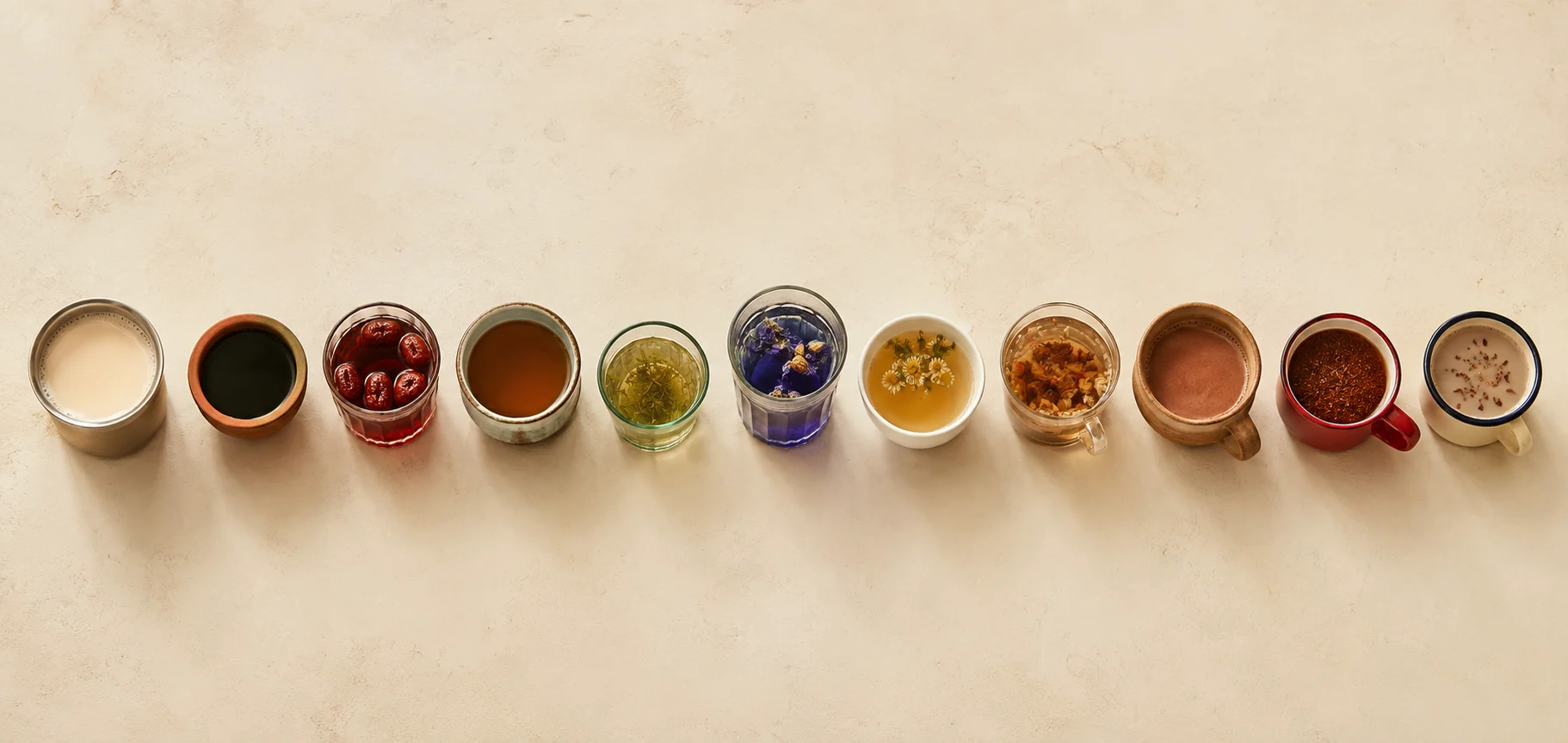
It is late, and you are still awake, and you have started doing the arithmetic — if I fall asleep now, that is five hours. Almost everyone alive has done that arithmetic. Here is what people hand each other, in eleven different kitchens, when it happens.
What almost everyone agrees on
Something warm, in a cup, held in both hands
Slightly sweet — honey, jaggery, a date, rock sugar
Almost never caffeinated, and where it is, it has been roasted until it isn't
At the same hour, every night, which turns out to matter as much as the cup
11 kitchens
Read in the order the sun finds them — west to east, following the numbers.
1from Mexico
Té de manzanilla
teh deh man-sa-NEE-ya
You need
Chamomile
Honey
Sometimes a little cinnamon
Steep and sweeten. Given to adults for sleep and to children for almost anything.
Manzanilla is the Mexican answer to a very long list of complaints. For sleep it is reached for without a second thought.
The same soft apple note as the Levantine cup, warmer for the cinnamon.
2from The Caribbean
Soursop leaf tea
You need
Dried soursop leaves
Hot water
Steep for ten minutes. Drunk in the evening, often nightly.
Bush tea for a restless night — part of the everyday household herbal practice of the islands.
Grassy and mild, a little like green tea without the astringency.
3from France
Tilleul
tee-YUH
You need
Dried linden blossom
Hot water
Steep five minutes. Traditionally taken after dinner, not at bedtime.
The tisane du soir — the evening infusion, and the one French grandmothers press on anyone who seems wound up.
Honeyed and faintly green, like the smell of a warm garden in June.
4from South Africa
Rooibos
ROY-boss
You need
Rooibos leaves
Hot water
Milk and honey if you like
Steep for five minutes — unlike black tea, it will not go bitter if you forget it.
Naturally caffeine-free, which is why it is drunk in the evening and why South African parents give it to babies with colic.
Round, red, faintly sweet on its own. Takes milk surprisingly well.
Drink it like builder's tea and it will behave like one.
5from The Levant
Babunaj
بابونجba-BOO-nej
You need
Dried chamomile flowers
Hot water
Honey
Steep, covered, for five minutes — covered matters, or the volatile oils leave with the steam.
In the Greco-Arabic tradition chamomile is cooling and relaxing, for a temperament that has run hot all day.
Soft, appley, familiar.
6from Iran
Gol gavzaban
گل گاوزبانgol gav-za-BAAN
You need
Dried borage flowers
Hot water
Rock sugar
Steep the flowers until the water turns a deep violet-blue. Sweeten with nabat.
Persian practice reaches for borage for a racing heart and an anxious evening.
Floral and gentle, a little like a mild hibiscus. The colour alone is worth it.
7from North India
Jaiphal doodh
जायफल दूधJIE-phal doodh
You need
A cup of milk
A pinch of grated nutmeg
A little ghee
Honey or jaggery, if you like
Warm the milk gently — never boil it hard. Grate in a very small amount of nutmeg, no more than a pinch. Stir in the ghee. Drink it in bed, not at the table.
Ayurveda calls nutmeg a nidrajanana — something that brings sleep. Turmeric milk gets all the attention abroad, but for sleep it is the nutmeg doing the work, and only a little of it.
Warm, faintly sweet, and woody at the back of it. Comfort more than flavour.
If you have had turmeric latte, this is its quieter, older cousin.
8from Vietnam
Trà tâm sen
cha tum sen
You need
Lotus plumule — the small green heart of the lotus seed
Hot water
A very small pinch, steeped briefly. More is not better here; it turns quickly bitter.
Cooling and quieting, for a mind Vietnamese practice would describe as overheated.
Green and genuinely bitter. An acquired cup, and people who love it, love it.
9from China
Suan zao ren tang
酸棗仁湯swan dzow ren tahng
You need
Sour jujube seed
Hot water
The seeds are simmered rather than steeped — twenty minutes or so, until the water darkens. Strain, and drink an hour before bed.
It has been prescribed for a restless mind for something like eighteen hundred years. Chinese medicine reads sleeplessness as a spirit that will not settle, and this is the formula it reaches for first.
Faintly sour, faintly nutty, more like a broth than a tea.
10from Korea
Daechu-cha
대추차DEH-choo cha
You need
Dried jujubes
A slice or two of ginger
Honey
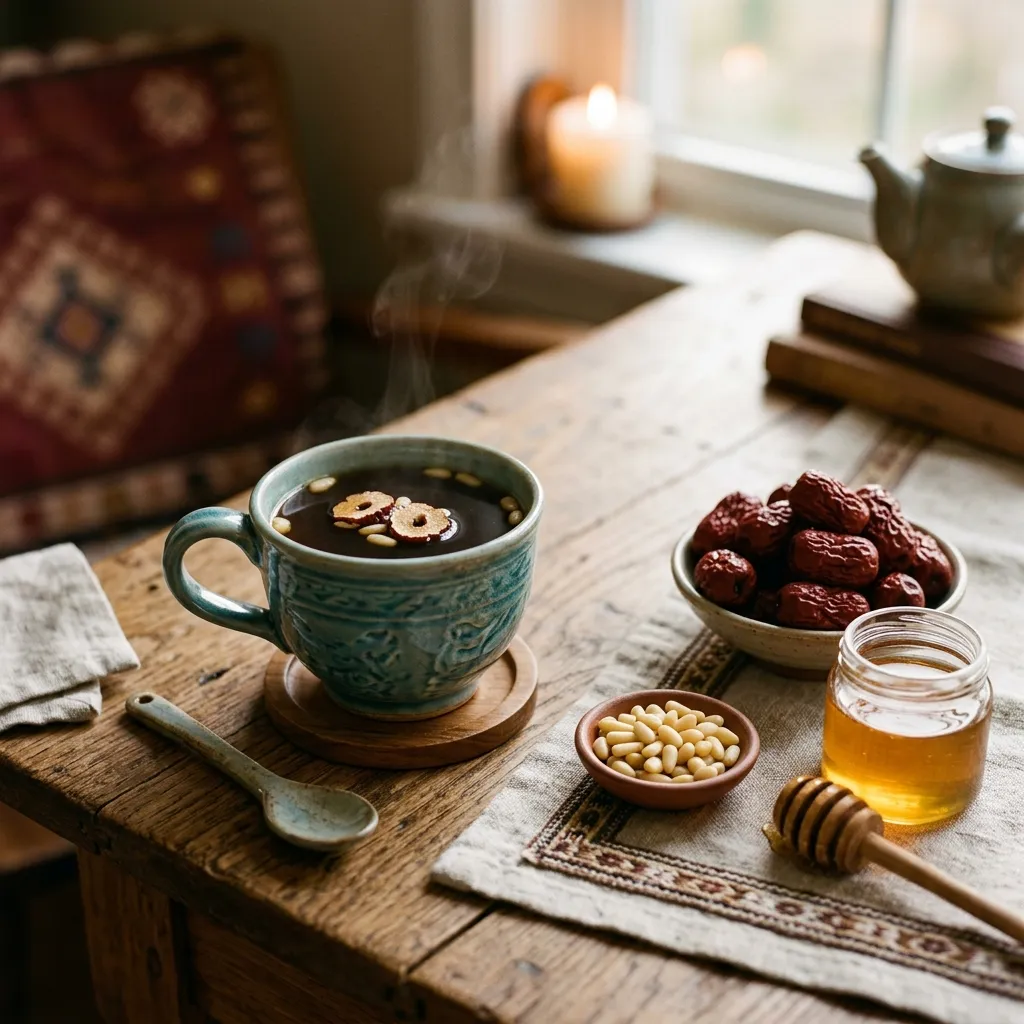
Simmer the jujubes until the water is deep red and the fruit has gone soft — twenty minutes at least. Sweeten with honey at the end, off the heat.
Jujube is considered calming and blood-nourishing — for the tired-but-wired, rather than the simply tired.
Like a warm, thin date syrup. Properly sweet, and the most comforting cup on this page.
Close to a date and ginger tea, if you have had one.
11from Japan
Hojicha
ほうじ茶HO-ji-cha
You need
Roasted green tea leaves
Hot water
Steep for thirty seconds in water just off the boil. That is all.
Roasting burns off most of the caffeine, which is precisely why it is the tea Japanese households drink in the evening and give to children. Nobody claims it as medicine. It is just what you have after dinner.
Toasty and mild, almost like a light coffee without any of the edge.
Now look at them together
Look at what they have in common. Four unconnected traditions — European, Levantine, Latin American, North African — independently reached for chamomile. Three East Asian ones independently reached for jujube. And nearly every cup here is warm, lightly sweet and free of caffeine, which suggests the ritual is doing as much work as the plant. A warm drink at a fixed hour is a signal to a nervous system, and every culture on earth seems to have worked that out without comparing notes.
Please see someone if
You have been sleeping badly for more than a few weeks and it is affecting your days
You snore heavily, or someone has noticed you stop breathing in your sleep
You wake at the same early hour every morning feeling low, and it has lasted
Sleeplessness began when you started a new medication
You are using alcohol to get to sleep
None of the above is medical advice. These are household preparations, described as the households that make them describe them. They sit alongside medical care and never in place of it.