The Severed Nose, and How It Reached Europe
Sushruta described the operation. Cowasjee received it. Carpue copied it. The paper trail survives —— and why the surgeon who performed it has no name.
In 1792, near the end of the Third Anglo-Mysore War, a bullock-cart driver named Cowasjee was captured by the forces of Tipu Sultan. He had been working for the British army. He and four others were sentenced to mutilation for it. Cowasjee lost his nose and one hand.
He lived without a nose for about twelve months. Then he got a new one — and the record of how is one of the very few places where you can trace a line from an ancient Sanskrit text, through a documented operation, into the standard practice of modern surgery.
What the text actually says
The Sushruta Samhita, a Sanskrit surgical compendium usually dated to around the middle of the first millennium BCE, contains an unusually practical set of instructions for rebuilding an amputated nose.
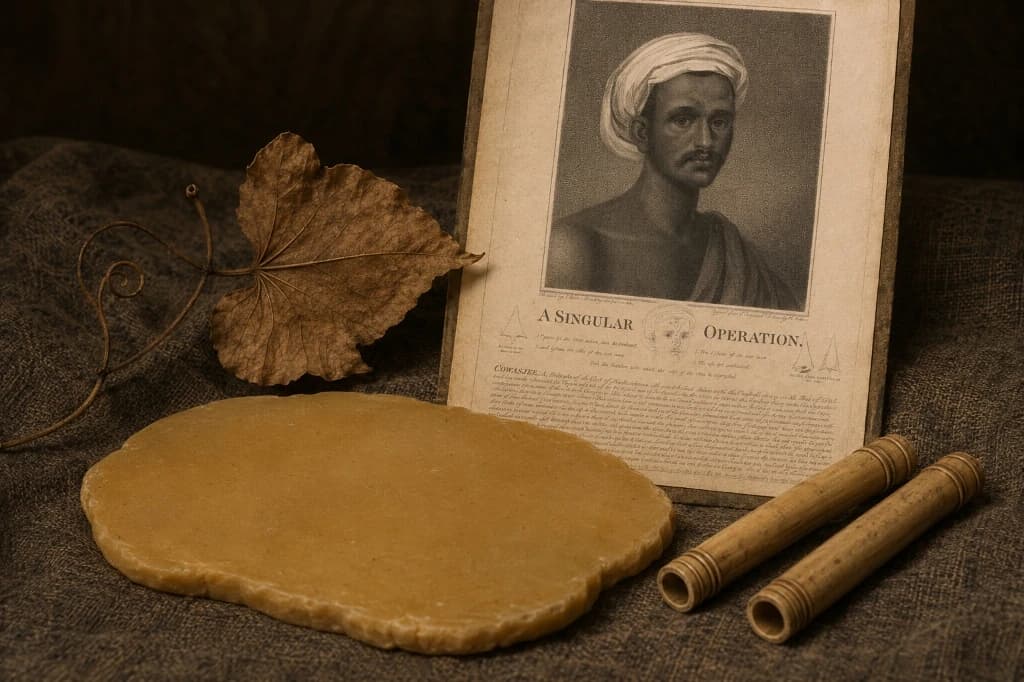
Take the leaf of a creeper, it says, and cut it to the size of the missing part — a template. Slice a matching patch of living flesh from the cheek, leaving a small strip still attached so the blood supply is never broken. Scarify the stump. Bring the flap across, stitch it into place, and hold the nostrils open with two hollow tubes of castor-oil plant so the new nose keeps its shape while it heals. Dress it with liquorice, red sandalwood and sesame oil. Later, once the tissue has united, trim it to size.
That is a pedicled flap: tissue moved to a new site while remaining connected to its original blood supply. It is the foundational concept of reconstructive surgery, described in the sixth century BCE with the pedicle explicitly justified on the grounds that circulation must be preserved.
One correction worth making, because almost everyone gets it wrong: Sushruta describes a cheek flap. The forehead flap that made the technique famous is a later Indian refinement, of uncertain date. Plenty of otherwise reputable sources — including major hospital websites — credit Sushruta with the forehead method. He didn't describe it.
The gap, and the families who filled it
Nose amputation remained a punishment in India for adultery, theft and dishonour for centuries, which meant continuous demand for people who could repair one. The skill survived not in universities but in families. The Kanghiara family of Kangra reportedly practised it from the 1440s. Others were Maratha communities near Poona and certain Nepali lineages. Techniques were taught to sons and daughters-in-law, and deliberately withheld from unmarried daughters so the craft couldn't leave the family by marriage.
Somewhere in that long transmission, the flap moved from the cheek to the forehead — better blood supply, better colour match, a more workable arc of rotation. Nobody recorded when or why.
1793: the operation
Sir Charles Malet, the British resident at Poona, heard of a man who could rebuild noses and sent for him on Cowasjee's behalf. British surgeons were present and took notes.
The account describes fitting a thin plate of wax to the nasal stump, flattening it, and laying it on the forehead as a pattern. Skin was dissected out along that outline, with a narrow slip left undivided between the eyes that slip, the writer explains, preserves the circulation until the new and old parts have joined. The flap was brought down, twisted half around, and inset into an incision cut around the base of the nose.
That is Sushruta's principle, executed with a different donor site and better instruments, roughly 2,300 years later.
How it got to London
The case appeared first in the Madras Gazette, then in the Gentleman's Magazine in London in October 1794, pages 891–92, under the heading "A Singular Operation," with an engraved portrait of Cowasjee and diagrams of the procedure. The letter was signed only "B. L." — most likely Barak Longmate, a genealogist rather than a surgeon, relaying an account from a friend in India.
It found its reader. Joseph Constantine Carpue (1764–1846), an English surgeon and anatomy lecturer, practised the method on cadavers and then waited — for years — for a suitable patient. In October 1814 he operated on an army officer whose nose had collapsed after prolonged mercury treatment. There was no anaesthesia; contemporary accounts put the operation at roughly fifteen minutes. He performed a second in 1815, and in 1816 published An Account of Two Successful Operations for Restoring a Lost Nose from the Integuments of the Forehead.
Two years later, Carl Ferdinand von Graefe published Rhinoplastik in Berlin, cataloguing three approaches. The first he listed was the forehead flap — the Indian method.
The part that stayed
The paramedian forehead flap remains the standard workhorse of major nasal reconstruction today. A surgeon rebuilding a nose after skin cancer in 2026 is executing a refined version of what those British officers watched in 1793, which is a refined version of what a Sanskrit text set down before the common era.
One name is missing from all of it. The man who rebuilt Cowasjee's nose is recorded only as a Kumhar — a member of the potter caste — from the Maratha country. The engraving that travelled to London shows the patient's face, not the surgeon's. He was, so far as the historical record allows, the most consequential operator in the whole chain, and nobody wrote down what he was called.
Sources: "B. L.", untitled letter, Gentleman's Magazine LXIV, October 1794, 891–92 · Royal College of Physicians Museum, "A 'Singular Operation'" · British Library, "Britain's first nose job" · Carpue JC, An Account of Two Successful Operations… (London, 1816) · Shaye DA, "The history of nasal reconstruction," Curr Opin Otolaryngol Head Neck Surg, 2021 · "Some remarks on the revival of rhinoplasty in Europe in the early nineteenth century"
Educational content, not medical advice. Ayurveda is complementary to medical care, never a replacement for it. Talk to a Vaidya or your doctor before changing anything you take.
Five minutes. No card.